
Nobody wants to spend their Saturday in a mechanic's waiting room just to get a form signed.
Whether you're getting approved for Uber, Lyft, or Turo, the idea of a quick virtual inspection from your driveway, in 15 minutes, sounds almost too good to be true.
Is virtual vehicle inspection reliable, or is it cutting corners?
Here's the straight answer.
What Is Virtual Vehicle Inspection?
A virtual vehicle inspection is a remote safety evaluation of your car conducted over a live video call, no shop visit required.
You connect with a certified mechanic through your smartphone or mobile device.
You walk through a standardized checklist on camera and receive a signed PDF report instantly by email, ready to upload to your rideshare app. Modern vehicle inspection solutions use live video streaming, AI-powered image analysis, and automated documentation, all in one inspection platform.
Services like DriveReady match ASE-certified mechanics with an easy-to-use video platform that combines human verification and technology.
It’s like having a video call with your mechanic instead of sitting in their waiting room.
The COVID-19 pandemic sped up this shift to digital solutions.
Vehicle owners, auto repair businesses, and rideshare platforms all needed a safer, contactless option for traditional manual inspections.
What began as a temporary fix quickly showed its worth, and digital vehicle inspections are becoming the new standard in the industry.
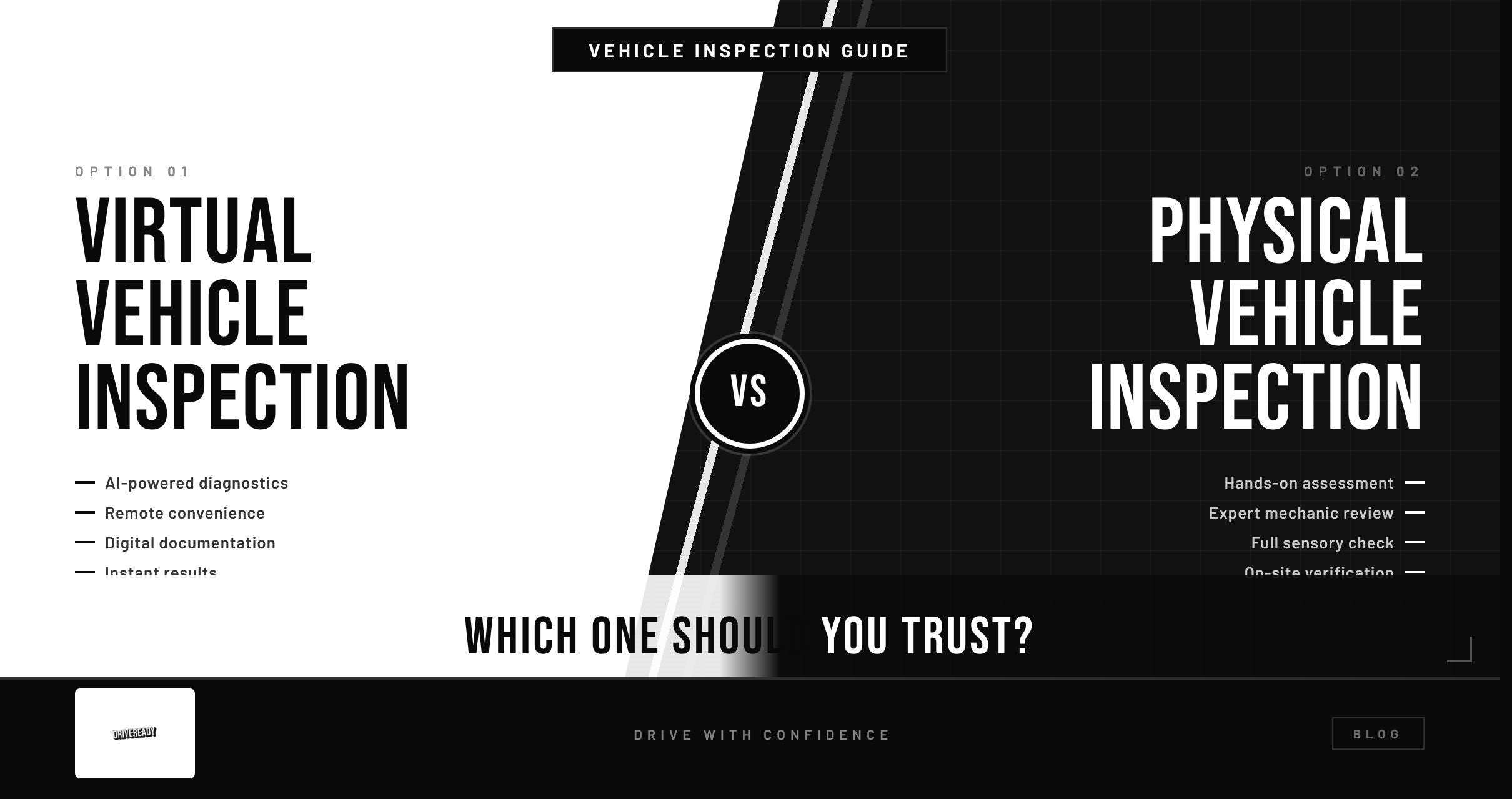
Virtual vs Physical Vehicle Inspection: The Real Difference
Both check the same things: lights, tires, brakes, wipers, mirrors, seatbelts, horn, and dashboard warning lights. The difference is how that verification happens.
In a physical inspection, you drive to a local auto shop or service center, wait your turn, and a mechanic manually checks each item, including things like brake pad wear and odometer readings.
In a virtual vehicle inspection, a certified inspector guides you through the same checklist over video, you become their eyes in real time.
|
Factor |
Virtual Inspection |
Physical Inspection |
|
Time required |
~15 minutes |
1–3+ hours |
|
Where it happens |
Your driveway |
Must drive to a shop |
|
Scheduling |
Same-day, evenings/weekends |
Often booked days out |
|
Cost |
$25–$50 |
$50–$150+ |
|
Report delivery |
Instant PDF |
Paper/pickup |
|
Wait time |
None |
30 min–2+ hours |
For most rideshare drivers, the table speaks for itself, but let's dig into reliability before you decide.
Is Virtual Vehicle Inspection Actually Reliable?
YES, for what it's designed to do.
Virtual inspections are built specifically for safety compliance checks, not full mechanical diagnostics.
The items checked, lights, tires, wipers, mirrors, seatbelts, horn, and visible damage are all accurately assessable through high-quality video.
ASE-certified inspectors conduct thorough inspections and know what worn tire tread looks like on camera.
They can spot a cracked windshield in the driver's sight line. They verify your horn and lights are live, so there's no guesswork.
Uber, Lyft, and Turo accept virtual inspection reports because they meet the same specific requirements as physical ones.
For standard rideshare compliance, virtual covers 95%+ of what platforms require.
What affects reliability:
· Lighting- daylight or strong artificial light, is essential
· Camera quality- any modern smartphone works fine
· Internet connectivity- stable 4G/5G or Wi-Fi required
· Inspector certification- always use ASE-certified professionals
Where virtual inspection has limits:
· Under-vehicle components (frame, suspension, exhaust)- difficult to see remotely
· Engine diagnostics- OBD scanning isn't possible virtually
· Hidden structural damage- requires physical access
· Emissions/smog testing- always requires in-person equipment
The gaps only matter in situations where physical inspection was always the right call anyway.
Benefits of Digital Vehicle Inspections
The benefits of digital vehicle inspections go well beyond just skipping the waiting room.
Speed & convenience: A 15-minute call replaces a half-day out. Same-day appointments, evenings, weekends, you get back on the road without losing income or rearranging your schedule. For any auto repair business or fleet operator, this kind of efficiency translates directly into better throughput and customer satisfaction.
Real cost savings: Virtual inspections run $25–$50 versus $50–$150+ at physical repair shops. No fuel, no unpaid wait time, no risk of being upsold. For service advisors managing high volumes, a streamlined approach to inspections means more vehicles processed, faster turnaround, and a more accurate repair estimate delivered to the customer upfront.
No geography barrier: Not everyone lives near certified service centers. Virtual inspection removes distance entirely, whether you're in a rural area, working night shifts, or simply have an unpredictable schedule. Vehicle owners in underserved areas benefit most from this accessibility.
Better documentation & fraud protection: Reports include photos and videos, creating a clear paper trail. This supports claims and underwriting accuracy, helps warranty providers validate claims, and enables sophisticated fraud detection by flagging inconsistencies in odometer readings or vehicle condition over time. Insurers like State Farm increasingly rely on this kind of digital evidence trail for efficient claims management.
Improved customer experience: A fast, transparent inspection process builds customer trust and customer loyalty. When vehicle owners can capture and submit their vehicle condition from their driveway and get a report in minutes, it creates a fundamentally better user experience than sitting in a waiting room. That translates directly into better reviews and stronger Google reviews for any platform or auto shop using these tools.
DVIs as a benchmark: In the auto repair industry, DVIs (digital vehicle inspections) are increasingly becoming the benchmark for transparent, efficient service. Shops implementing digital vehicle inspections report improved efficiency and customer satisfaction, with customers appreciating the ability to see exactly what was inspected and why.
Use Cases: Where Virtual Inspection Shines
The use cases for virtual vehicle inspection span across multiple industries:
· Rideshare drivers- Quick, same-day approval for Uber, Lyft, and Turo without shop downtime
· Fleet operators- Implementing digital vehicle checks across dozens of vehicles simultaneously using a digital vehicle inspection app, saving significant time and overhead
· Insurance providers- Photo and video documentation supports faster, more accurate claims and underwriting decisions
· Used car platforms- Remote visual checks give buyers and sellers a transparent view of vehicle condition before purchase
· Auto repair shops- Software solutions and AI-powered inspection platforms help service advisors perform thorough checks, identify potential issues early, and present findings to customers in a way that drives trust and approval rates
Inspections are becoming a core part of the digital customer journey, not just a regulatory checkbox.
Shops that embrace digital vehicle inspection tools as part of their workflow see measurable improvements in efficiency and customer satisfaction, reduced disputes, and stronger customer loyalty over time.
When to Choose Virtual vs. Physical
Choose virtual vehicle inspection when:
· Your vehicle is in good condition, and you need rideshare/Turo approval fast
· You want same-day turnaround without shop wait times
· You manage multiple vehicles and need to reduce costs at scale
· You want a seamless integration with your rideshare platform workflow
· You want to avoid unnecessary upsells at physical auto repair shops
Choose physical inspection when:
· Your state legally requires an in-person inspection sticker
· You're buying a used car and need a full pre-purchase mechanical review
· Your car has active dashboard warning lights or known mechanical issues
· You need emissions or smog certification
Many smart drivers use both, virtual for quick compliance renewals, and an annual in-person visit for deeper, more thorough mechanical checks.
Right tool, right time.
The Industry Has Already Moved
Virtual inspection adoption isn't experimental, it's mainstream.
Uber, Lyft, and Turo accept virtual reports across most U.S. markets.
Insurance companies use photo and video assessments for the automotive claims process.
Used car platforms use remote visual inspections as part of their buying process.
Fleet operators use digital vehicle inspection tools and automation to monitor vehicle condition efficiently across locations.
AI-powered capabilities are pushing the space further; automated damage detection, pre-screening flags, predictive maintenance, and seamless integration with existing software solutions are all part of where inspection technology is heading.
Digital vehicle inspections are becoming the default, not a workaround, but the smarter standard.
Conclusion
For rideshare and car-sharing platform approvals, a virtual vehicle inspection conducted by an ASE-certified mechanic is just as valid as going to a shop, and significantly faster and cheaper.
Customer satisfaction is high, the user experience is genuinely seamless, and adoption across the auto repair industry continues to grow.
Where virtual has limits, engine diagnostics, structural damage, and emissions, those were always physical-inspection scenarios anyway.
For the vast majority of vehicle owners and drivers? Virtual is the smarter choice.
Ready to get approved today? Book your virtual inspection with DriveReady, ASE-certified, same-day, guaranteed acceptance or your money back.
